You can find the original work here (preprint).
The brain relies on a sensitive balance between excitation (increasing activity) and inhibition (decreasing activity). In autism, this balance (E/I) is often hypothesised to be atypical. We used EEG’s “1/f slope”—a proxy for E/I dynamics—to investigate this. Prior studies looking at E/I balance in autistic adults at rest have yielded mixed or null findings.
Important to remember:
Steeper slope = more inhibition.
Flatter slope = more excitation.
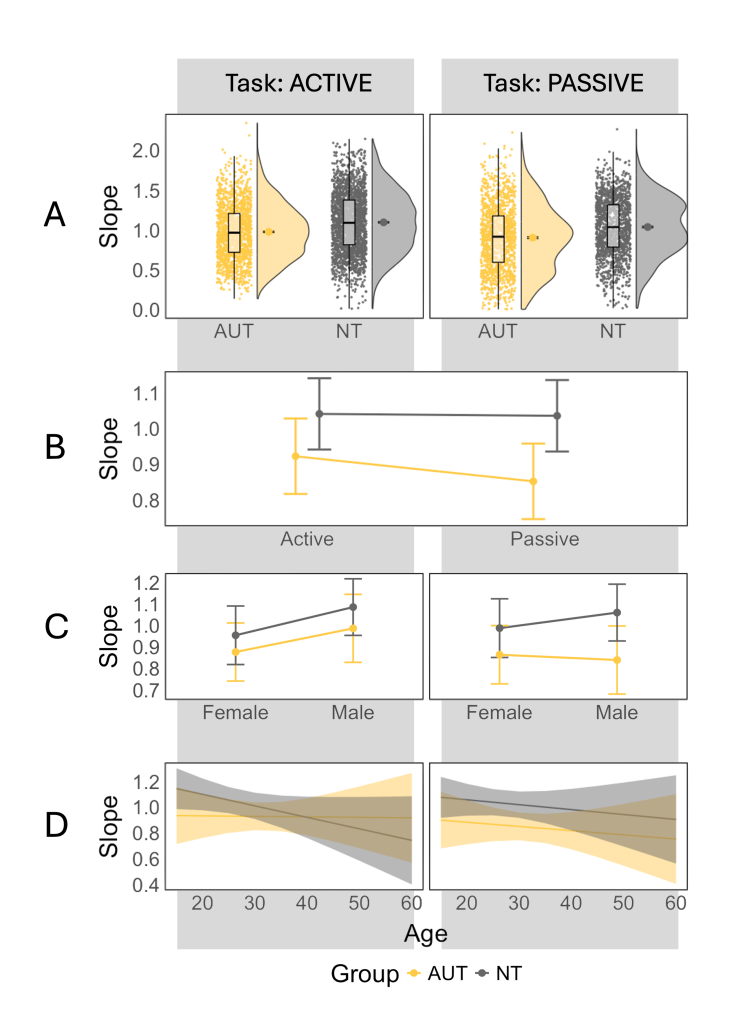
We asked: Does this balance change when the brain is actively working?
We measured aperiodic activity in autistic (AUT) and neurotypical (NT) adults during passive viewing vs. an active, goal-directed task (word identification).
We found a key difference in how the brain responded to the task demands. NT adults showed no significant change in their E/I balance between passive and active conditions. However, AUT participants showed significantly steeper slopes (meaning an increase in inhibition) during the active task compared to passive viewing – see panel B in the figure above.
This suggests that aperiodic activity is not a static marker, but a dynamic one. The increase in inhibition observed in the AUT group when they engaged in the active task may reflect a compensatory inhibitory process. Understanding the dynamic response to task demands is essential for future autism research!
Want to know more? Listen to this overview of the paper in simple language made by notebookLM:
 MagdaLena Matyjek, Ph.D.