Research topics
I am interested in many topics oscillating around human social cognition and autism. This includes communication and interaction in autism, reward processing, and processing and integration of multisensory social cues (like speech).
Methods
I am trained as a neuropsychologist, which means that I use neuro (and physiological) methods, like EEG (and pupillometry) as biomarkers of psychological/cognitive functioning of the human brain.
Social interaction style in autism
Matyjek M., Dziobek, I., Hamilton, A., Whetley, T. (2025; preprint) Social Interaction Style in Autism: A critical review of social behaviours and outcomes in autistic and neurotypical interactions. PsyArxiv.
Persistent social difficulties in autism can be attributed, at least in part, to the challenge of interacting with a predominantly non-autistic world. This project investigates the behavioural dynamics of social interactions, focusing on understanding the factors influencing communication “mismatch” between autistic and non-autistic individuals, particularly within same-neurotype and mixed-neurotype dyads. By providing insights into effective communication strategies, the project seeks to foster a methodologically sound understanding of social interactions across neurotypes.
We started with a review of the existing literature looking into social behaviours and synchrony in dyadic interactions between autistic and neurotypical adults. Now, we are analysing data from 100+ online interactions with same- and mixed-neurotype dyads and setting up a larger study which will also look into neural and physiological synchrony between interacting individuals.
Multisensory integration in autism
Matyjek, M., Kita, S., Torralba Cuello, M., & Soto Faraco, S. (2025), Multisensory Integration of Naturalistic Speech and Gestures in Autistic Adults. Autism Research, 45 (11), e26797 (OA).
Matyjek, M., Kita, S., Torralba Cuello, M., & Soto Faraco, S. (2025), Multisensory Integration of Speech and Gestures in a Naturalistic Paradigm. Human Brain Mapping, 45:e26797 (OA).
Our natural social environments and interactions require making sense of a myriad of information coming through different sensory channels. For example, to understand another person speak, we need to process auditory (words, prosody) and visual (lip movements, gestures, mimicry) cues and integrate multimodal information coming from different sensory channels as belonging to one event. There is mounting evidence that persons with autism experience difficulties in these functions, which may underlie the core symptoms of autism: social impairments. In this project we investigate how the neurotypical and autistic brain realises audio-visual processing and integration in speech.
We find that the autistic brains rely on different neural mechanisms than the neurotypical brain to integrate audio-visual speech and gestures, but both groups arrive at a similar behavioural benefit from the multimodal presentation. In short: Autistic adults benefit from audio-visual speech as much as neurotypicals, but the autistic brain interprets this function differently, while still achieving equal efficiency.
Reward processing in autism and typical development
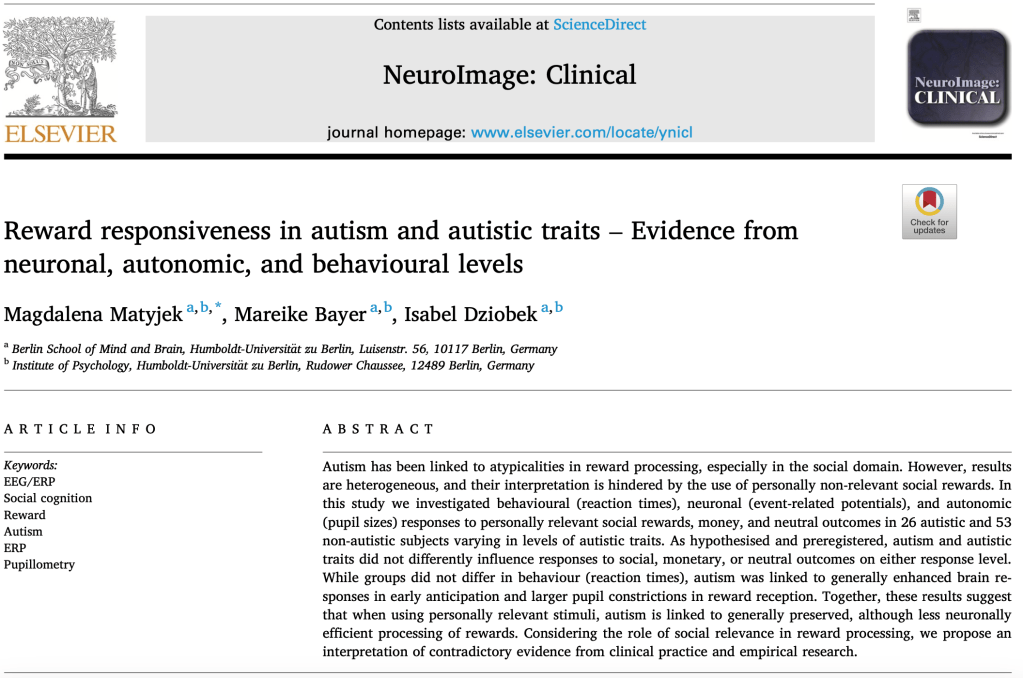
Matyjek, M., Bayer, M., & Dziobek, I. (2022), Reward Responsiveness across Autism and Autistic Traits – Evidence from Neuronal, Autonomic, and Behavioural Levels, NeuroImage: Clinical, 38, 103442 (OA).
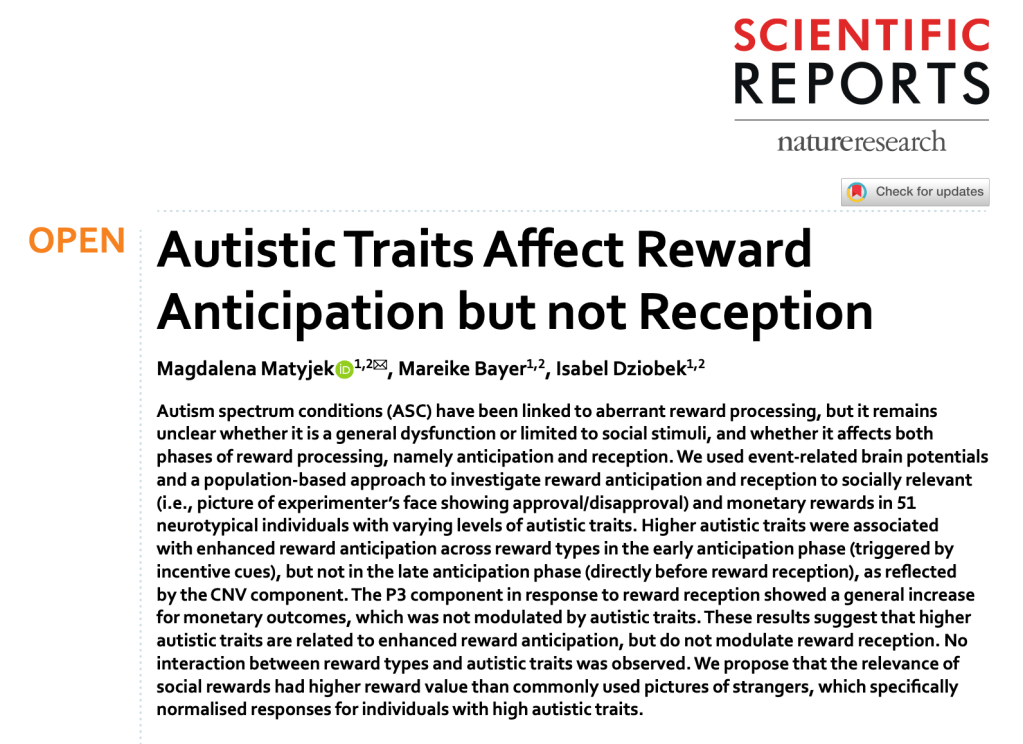
Matyjek, M., Bayer, M., & Dziobek, I. (2020), Autistic Traits Affect Reward Anticipation but not Reception. Scientific Reports 10, 8396 (OA).
Matyjek, M., Meliss, S., Dziobek, I., & Murayama, K. (2020), A Multidimensional View on Social and Non-social Rewards. Frontiers in Psychiatry, 11, 818 (OA).
Matyjek, M., Bayer, M., & Dziobek, I. (2021), Pupillary Responses to Faces are Modulated by Familiarity and Rewarding Context. Brain Sciences, 11, 794 (OA).
The social motivation hypothesis of autism proposes that the social difficulties in this population may be rooted in diminished responsively to social stimuli and rewards. Thus, the question is whether individuals with autism (and those with higher autistic traits) find social rewards, like a smile, less rewarding than neurotypical individuals, and whether this pattern changes when facing monetary rewards.
This project comprises two main studies. One looks into the neural correlates of reward processing in the general population with varying levels of autistic traits (see the Scientific Reports paper) and the other investigates neural, physiological, and behavioural reward processing related to autistic traits in adults with and without the Autism Spectrum Diagnosis (see the NeuroImage: Clinical study). In short, when using social relevant stimuli (a picture of the smiling main experimenter instead of stranger as a social reward), we find that autistic traits are linked to enhanced reward responses, both in the clinical and sub-clinical population. At the same time, we are not finding differences in behaviours. So: the autistic brain realises the reward function differently than the neurotypical one, but arrives at similar behaviour.
Reward processing is crucial in the human functioning: it allows us to learn and reinforce certain behaviours. In reward research, we often compare social reward to non-social ones, but it is easy to forget that particular stimuli differ in more dimensions than only sociality, for example tangibility, proximity, primacy, etc. thus, we discussed these and proposed a multidimensional view on rewards – you can read a simple summary here.
Even when considering only social rewards, like faces, we have to acknowledge that they differ in how familiar (known, recognisable) and socially relevant (personally important) they are. Do those influence how rewarding they are too? We compared how people process smiling faces of different familiarity and social relevance levels when they serve as feedback and when they simply appear on the screen. Read a simple words summary here!
Social cognition in autism
Matyjek, M., Bast, N., & Soto Faraco, S. (2025), Preference for Social Motion in Autistic Adults. Psychophysiology, 62 (4), e70053 (OA).
Autism is often associated with differences in social attention, and how much autistic children look at social motion (moving human faces) over non-social motion (geometric shapes) could be applied to screen and prioritise potentially autistic persons for diagnosis and support services. Our study investigated whether these differences persist into adulthood. We found that adult autistic participants spontaneously looked less at video-clips containing social motion compared to their non-autistic counterparts, and showed faster and larger pupillary responses to social motion, which could be an indication of increased cognitive effort in interpreting social information. These findings suggest that the lowered social motion preference in autism persists across lifespan.
Affect/emotions in face processing

Matyjek, M., Kroczek, B., Senderecka, M. (2021), Socially Induced Negative Affective Knowledge Modulates Early Face Perception, but not Gaze-Cued Attention. Psychophysiology, 00:e13876. (OA)
Schneider, J., Matyjek, M., Weigand, A., Dziobek, I., and Brick, T. R., (2022), Subjective and objective difficulty of emotional facial expression perception from dynamic stimuli. PLOS ONE, 17(6): e0269156 (Open Access).
Faces are complex stimuli which carry heaps of information. Over thousands of years of evolution, humans became experts in processing faces, but there are still many aspects we do not fully understand. For example, for a long time it was believed that higher cognition does not penetrate perception of faces. However, we found that previous negative affective knowledge about others influenced very early neural responses to their faces. See a summary here.
Recognising emotions in others can be easy or it can be hard, depending on a number of factors context, our ability to read their expressions, characteristics of the person, etc. We investigated what exactly plays a role in how difficult emotion perception is and found that the most important factors were arousal and valence of the emotional expression, and gender and age of both actors and observers.
 MagdaLena Matyjek, Ph.D.